
Cervicogenic Headache Treatment, Varsity Lakes - Gold Coast
If you've been dealing with persistent headaches and aren't getting answers, there's a chance your neck is the source — not your head. Cervicogenic headache is one of the most commonly missed causes of chronic head pain, yet it responds very well to the right treatment. At Head, Neck & Balance Clinic in Varsity Lakes, Our Osteopath - Jake Martin assesses and treats cervicogenic headache using a structured, evidence-based approach that looks at the whole picture — not just your symptoms.
What Is a Cervicogenic Headache?
A cervicogenic headache is a secondary headache — meaning the pain you feel in your head is actually coming from a problem in your neck. The upper three cervical vertebrae (C1, C2 and C3) share nerve pathways with the trigeminal nerve, which supplies the face and head. When structures in your upper neck — joints, discs, muscles or ligaments — become irritated or dysfunctional, they can send pain signals that your brain interprets as a headache.
What Causes Cervicogenic Headache?
Cervicogenic headaches are most commonly driven by dysfunction in the upper cervical joints — particularly the C1-2 and C2-3 segments. A number of factors can contribute:
Posture and prolonged sitting. Forward head posture — where the head drifts in front of the shoulders — places significant stress on the upper cervical joints and muscles. This is especially common on the Gold Coast, where desk work, driving, and screen time dominate daily life.
Whiplash and trauma. Motor vehicle accidents and sports injuries can strain or irritate the joints, discs and ligaments of the cervical spine, creating an ongoing source of referred head pain.
Facet joint arthritis and disc degeneration. Gradual wear and tear in the cervical spine — particularly at C2-3 — can generate the type of low-grade, persistent nociceptive input that sensitises the brainstem and triggers headache.
Muscle tension and trigger points. Overactive muscles in the neck and suboccipital region, including the upper trapezius, semispinalis and suboccipitals, are commonly involved and can perpetuate symptoms.
Stress and sleep disruption. Psychological stress and poor sleep can amplify pain sensitivity, making cervicogenic headaches harder to manage without addressing the whole person.
Common Symptoms
Cervicogenic headaches tend to have a recognisable pattern. Symptoms may include:
Headache starting at the base of the skull and radiating toward the forehead or eye
Pain that is usually one-sided (though it can occasionally be bilateral)
Neck stiffness or reduced range of movement
Headache that worsens with certain neck positions or sustained postures
Tenderness at the top of the neck or base of the skull
Nausea or light sensitivity in some cases
Headache that is aggravated by prolonged sitting, screen use or driving
How Is Cervicogenic Headache Diagnosed?
There is no single blood test or scan that confirms cervicogenic headache. Diagnosis relies on a thorough clinical assessment that combines your history with hands-on examination findings.
At Head, Neck & Balance Clinic, Jake takes a detailed history first — asking about the location, behaviour, frequency and triggers of your headaches, as well as relevant factors like trauma, posture, stress and previous treatment. This helps distinguish cervicogenic headache from primary headaches like migraine and tension-type headache, and screens for any serious underlying causes (red flags) that may need further investigation.
The physical examination includes assessment of your cervical range of motion, palpation of the upper cervical joints and soft tissues, and specific provocation tests. One highly useful clinical test is the Flexion-Rotation Test, which assesses mobility at the C1-2 segment. Research has shown this test has a sensitivity of 86% and specificity of 100% for cervicogenic headache originating at C1-2, making it one of the most diagnostically reliable tests in manual therapy practice.
Where relevant, neurological screening is also performed to rule out involvement of the spinal cord or nerve roots.
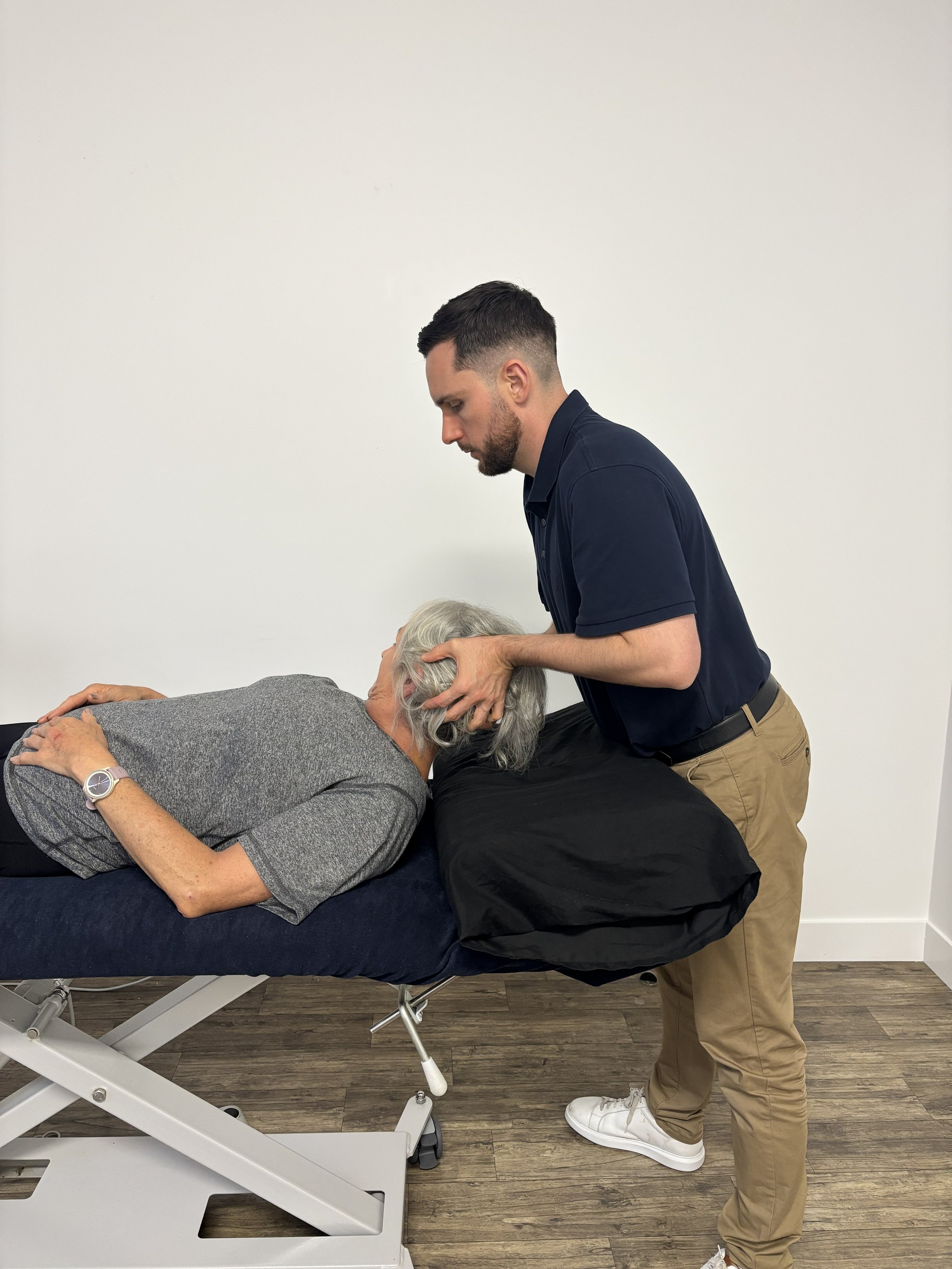
Cervical Flexion Rotation Test
How Can an Osteopath Help with Cervicogenic Headache?
Osteopathic treatment for cervicogenic headache focuses on identifying and addressing the mechanical source of your pain in the cervical spine. At Head, Neck & Balance Clinic, Varsity Lakes, we use a systematic approach informed by current clinical evidence.
Manual therapy to the upper cervical spine. Targeted joint mobilisation and manipulation of the C1-2 and C2-3 segments can reduce joint stiffness, decrease local nociceptive input, and directly address the source of referred head pain. Evidence consistently supports manual therapy as an effective treatment for cervicogenic headache.
Exercise rehabilitation. Deep neck flexor endurance, motor control and postural correction exercises are prescribed to address the underlying drivers of your headache and reduce the likelihood of recurrence.
Lifestyle Optimisation. Changes to diet, daily exercise, sleep and stress levels can all help with the management of headahce.
If your headaches haven't responded to general treatment elsewhere, this integrated approach can make a significant difference.
Cervicogenic Headache vs Migraine — What's the Difference?
It can be difficult to tell these two types of headache apart, and they do share some features — including one-sided head pain, nausea and light sensitivity. However, there are important distinctions.
Migraine is a primary headache disorder involving changes in brain chemistry and neural excitability. It tends to be episodic, is often preceded by an aura, and is not consistently linked to neck movement or posture.
Cervicogenic headache, by contrast, is a secondary headache with a structural origin in the upper cervical spine. It is characteristically worsened by neck movement or sustained postures, and the pain can be reproduced by applying pressure to the upper cervical joints.
Interestingly, research suggests that sensitisation at the trigemino-cervical nucleus — the brainstem region where upper cervical and trigeminal nerve fibres converge — may play a role in both conditions. This means cervical dysfunction may actually contribute to migraine in some patients. Our assessment takes this overlap seriously, which is why a thorough cervical examination is part of every headache workup at Head, Neck & Balance Clinic.
For more information on headache types, see Healthdirect — Headaches.
Frequently Asked Questions
Can an osteopath treat cervicogenic headache on the Gold Coast? Yes. Osteopaths are well-trained in the assessment and treatment of cervicogenic headache. Head, Neck & Balance Clinic in Varsity Lakes on the Gold Coast focuses specifically on head, neck and balance conditions, including cervicogenic headache. We use a structured clinical examination and evidence-based manual therapy and exercise rehabilitation to address the source of your headaches, not just the symptoms.
How many sessions will I need? This varies depending on the severity and duration of your condition. Many patients notice meaningful improvement within 3–6 sessions. We will discuss expected timelines at your first appointment and will continuously reassess your progress. The goal is to get you better as efficiently as possible and equip you with the tools to maintain your results long term.
Do I need a referral to see an osteopath on the Gold Coast? No referral is needed. You can book directly online at headneckbalance.com.au/book-appointment or by calling 07 5679 0638
Is cervicogenic headache serious? In most cases, cervicogenic headache is a mechanical problem that responds well to conservative treatment. It is not dangerous in itself. However, our osteopath performs a thorough red flag screen at your first appointment to rule out rare but serious causes of headache — including vascular, neurological or inflammatory conditions — before proceeding with treatment. Your safety is always the first priority.
How long does treatment take to work? Many patients experience some relief within the first one to two sessions, particularly after manual therapy targeting the upper cervical joints. However, lasting improvement typically requires several sessions combined with a home exercise programme. Pain that has been present for months or years may take longer to resolve, but even longstanding cervicogenic headache responds well to the right treatment approach.
Book an Appointment for Cervicogenic Headache
If you are experiencing cervicogenic headache in Varsity Lakes or anywhere on the Gold Coast, Jake Martin at Head, Neck & Balance Clinic can help. Jake takes the time to properly assess your neck and identify the structures contributing to your headaches — so you get targeted, effective treatment rather than a one-size-fits-all approach.
Written by Jake Martin, Osteopath at Head, Neck & Balance Clinic, Varsity Lakes. Jake holds a degree in Osteopathy from Southern Cross University and is a Certified Complete Concussions Provider, focusing on the assessment and treatment of headaches, neck pain, jaw pain (TMD), dizziness and concussion on the Gold Coast.
📍 194 Varsity Parade, Varsity Lakes QLD 4227
📞 07 5679 0638
✉️ info@headneckbalance.com.au